 By hisscripture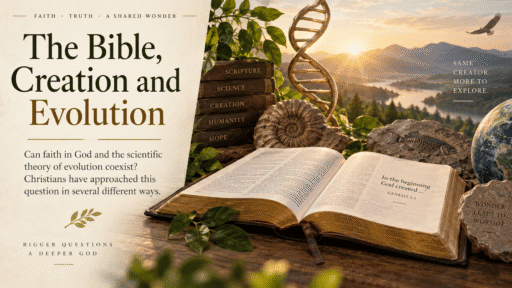
Evolution and Christianity are sometimes presented as complete opposites: either you believe God created life, or you believe in evolution.
In reality, the discussion is more complicated.
Christians agree that God is the Creator, but they do not all agree about exactly how the creation accounts in Genesis should be interpreted or whether evolutionary processes could have been part of God’s method of creation.
So what does the Bible actually say about evolution? Can a Christian accept the scientific evidence for evolution while still believing that God created humanity? Or does Genesis require us to reject evolution entirely?
To answer these questions, it is important to understand both what evolutionary science claims and what Scripture actually teaches.
What Is Evolution?
In biology, evolution describes changes in inherited characteristics within populations over many generations.
Small genetic variations occur within living things. Some variations can make organisms better suited to their environment, allowing those characteristics to become more common over time through processes such as natural selection.
Given enough time, accumulated changes can contribute to the development of new species.
When scientists speak about human evolution, they are not saying that humans descended from the monkeys alive today. Rather, the scientific understanding is that humans and other primates share ancient common ancestors.
Evolution attempts to explain how biological life has changed over time.
It does not, by itself, answer larger philosophical or theological questions such as why the universe exists, whether God exists, why human life has value, or whether creation has a purpose.
Those are different questions.
What Does the Bible Say About Creation?

The Bible begins with a very clear statement:
“In the beginning, God created the heavens and the earth.”
— Genesis 1:1, WEB
Whatever view a Christian takes concerning evolution, the Biblical foundation is that creation ultimately comes from God.
Genesis then describes God creating light, the heavens, land, plants, animals, and finally humanity.
Genesis 1:27 says:
“God created man in his own image. In God’s image he created him; male and female he created them.”
— Genesis 1:27, WEB
This teaches something particularly important about humanity.
Human beings are not presented merely as another animal. We are described as being made in the image of God.
Exactly what being made in God’s image includes has been discussed by Christians for centuries, but it gives humanity a unique dignity, responsibility, and relationship with the Creator.
Does Genesis Describe Evolution?
Genesis does not directly discuss evolution in the modern scientific sense.
Charles Darwin published On the Origin of Species thousands of years after Genesis was written, and the Biblical authors were not attempting to explain genetics, DNA, mutation, fossils, or natural selection.
Instead, Genesis answers foundational theological questions:
Who created everything?
God.
Does creation have purpose?
Yes.
Are human beings significant?
Yes. Humanity is created in God’s image.
Is creation ultimately independent of God?
No. Everything owes its existence to Him.
The disagreement between Christians usually begins when asking how Genesis describes the process and timing of creation.
Different Christian Views of Evolution
There is no single Christian interpretation of exactly how scientific evolution relates to Genesis.
Several major views exist.
Young-Earth Creationism
Young-Earth Creationists generally understand the creation days in Genesis 1 as six ordinary 24-hour days.
From Biblical genealogies, they commonly conclude that the Earth is thousands rather than billions of years old.
Under this interpretation, humans and the major groups of animals were created separately by God, and common ancestry between humans and other animals is rejected.
Supporters of this position believe that this reading most naturally preserves the historical nature of Genesis.
Old-Earth Creationism
Old-Earth Creationists accept the scientific evidence that the Earth and universe are extremely old while still believing that God specially created different forms of life.
Some interpret the “days” of Genesis as representing long periods rather than ordinary 24-hour days. Others understand Genesis as using a literary structure rather than providing a scientific chronology.
Depending on the particular view, limited evolutionary change may be accepted while universal common ancestry or human evolution may still be rejected.
Evolutionary Creation or Theistic Evolution
Other Christians believe that God created life through evolutionary processes.
This position is sometimes called evolutionary creation or theistic evolution.
Under this view, evolution describes a mechanism through which God’s creation developed, rather than providing an alternative to God.
Someone holding this position might therefore say:
“God created life, and evolution was part of how His creation developed.”
For these Christians, Genesis primarily reveals who created the world and why, rather than giving a scientific description of exactly how each species appeared.
What About Adam and Eve?
Adam and Eve are one of the most difficult areas in discussions about Christianity and evolution.
Genesis 2:7 says:
“Yahweh God formed man from the dust of the ground, and breathed into his nostrils the breath of life; and man became a living soul.”
— Genesis 2:7, WEB
Christians interpret this passage in different ways.
Some believe Adam and Eve were directly and specially created by God without evolutionary ancestors.
Others believe God may have used evolutionary processes to produce the human body before calling or establishing the first humans in a unique relationship with Him.
Still others understand parts of the Adam and Eve account as theological or symbolic while nevertheless believing that it communicates real truths about humanity, sin, responsibility, and our relationship with God.
This remains an important area of disagreement between Christians.
Does Evolution Disprove God?
Evolution itself does not prove or disprove the existence of God.
Science studies the natural world by observing evidence and investigating natural processes.
Christian faith makes a different kind of claim: that behind the existence of the universe and the laws governing it is a Creator.
Suppose someone discovered exactly how every stage of biological development occurred. A theological question would still remain:
Why does a universe capable of producing life exist at all?
For a Christian who accepts evolution, discovering a natural process does not necessarily remove God from the picture.
Consider rainfall. We understand evaporation, condensation, atmospheric pressure, and precipitation, yet a Christian can still thank God for rain.
Understanding a mechanism does not automatically answer the deeper question of why that mechanism or the universe containing it exists.
The Bible Encourages Us to Look at Creation
The Bible repeatedly points toward the natural world as something that reveals the greatness of its Creator.
Psalm 19:1 says:
“The heavens declare the glory of God.
The expanse shows his handiwork.”
— Psalm 19:1, WEB
Christians therefore should not be afraid of studying creation.
Whether looking through a telescope at distant galaxies, studying DNA, examining fossils, or simply watching animals in nature, we are investigating a world that Christianity says ultimately belongs to God.
Scientific discoveries may cause us to reconsider particular interpretations, but seeking to understand creation does not have to mean rejecting the Creator.
My Personal Reflection
For me, one of the most helpful things when thinking about evolution and Christianity is recognising that I do not necessarily have to choose between loving Scripture and honestly considering scientific evidence.
There can sometimes be pressure to believe that asking questions shows a lack of faith. I do not think it has to.
If God created the universe, then discovering how that universe works should ultimately lead us toward truth rather than away from it.
At the same time, I do not think science can answer every question that matters.
Science can investigate how human bodies developed, how old fossils are, or how species are related. But it cannot tell me why human life has value, why anything exists in the first place, or what my relationship with God should be.
Those are questions that go beyond biology.
I believe it is possible to approach this subject with humility. We can take the Bible seriously while recognising that sincere Christians have interpreted parts of Genesis differently.
For me, the most important truth remains the opening declaration of Scripture:
“In the beginning, God created the heavens and the earth.”
However creation unfolded, Christianity ultimately points beyond creation itself to its Creator.
Can Christians Believe in Evolution?
The answer depends partly on what someone means by evolution and how they interpret Scripture.
Many Christians accept evolutionary science and believe that it can be compatible with faith in God.
Other Christians believe that certain evolutionary claims, particularly concerning human origins, conflict with a straightforward reading of Genesis and therefore reject them.
Both groups may sincerely affirm the central Biblical claim that God is Creator.
It is therefore useful not to reduce this discussion to “science versus Christianity.”
There are scientists who are Christians. There are Christians who reject evolution. There are Christians who accept portions of evolutionary theory, and there are Christians who believe evolution was one of the processes God used in creation.
These differences deserve thoughtful discussion rather than hostility.
Faith, Science and Humility
The Bible was not written as a modern biology textbook.
Its purpose is far greater than explaining genetics or fossil records. Scripture tells the story of God, creation, humanity, sin, redemption, and ultimately Jesus Christ.
Science can help us investigate the physical history of life.
Scripture helps us understand creation in relation to its Creator.
There will continue to be debates about how these two areas fit together, particularly when discussing Genesis, Adam and Eve, and human origins.

Christians do not have to pretend those questions are simple.
We can investigate them honestly, listen to different interpretations, study Scripture carefully, and remain humble about what we know.
Whatever position we eventually reach on evolution, the central Biblical message about creation remains:
The universe is not meaningless.
Human life has value.
Creation belongs to God.
And behind everything that exists stands the One Scripture introduces with its very first words:
“In the beginning, God created the heavens and the earth.”
Continue Exploring the Bible
Questions about creation, evolution, science, and faith can lead to deeper study of Scripture and a greater understanding of what Christians believe.
If you found this article helpful, you can continue exploring more Bible verses, explanations, and Christian topics here on His Scripture.
Whether you are new to the Bible, returning to faith, or simply looking for answers to difficult questions, take your time, read the Scriptures for yourself, and keep seeking truth with an open heart.
You may also enjoy reading:
- Psalm 19:1 – The Heavens Declare the Glory of God
- John 1:1-14 – The Word Became Flesh
- John 3:16 – For God So Loved the World
- Romans 5:8 – Christ Died for Us
- Revelation 21:3-4 – God Will Wipe Away Every Tear
Explore more Bible verses and Christian articles on His Scripture.