 By hisscripture
Introduction
Many of us ask this question more urgently when the world feels unstable: Are we living in the end times? When wars continue, disasters dominate the news, and public life feels morally confused, it is easy to wonder whether Jesus’ return must be close. Christians have been asking this question for centuries, but the Bible calls us to respond with faith, wisdom, and a steady heart rooted in Scripture and regular time in God’s Word. It takes it seriously. But it also refuses to let us answer it carelessly.
The most balanced Christian answer is this: yes, in one important biblical sense, Christians believe we are already living in the last days. The New Testament speaks that way because Jesus has already come, died, risen, and poured out His Spirit. Yet that does not mean Christians can treat every headline as a secret code or draw a confident calendar of the final events. Scripture calls us to watchfulness, not panic; faithfulness, not frenzy.
What Christians mean by the end times
When many people hear “end times”, they think only of the final crisis immediately before Jesus returns. But the New Testament often uses “last days” more broadly. At Pentecost, Peter says Joel’s prophecy about the Spirit is being fulfilled “in the last days”. Hebrews says that God has spoken to us “in these last days” by His Son. John tells his readers that it is “the last hour”. Paul tells Timothy that the last days bring seasons of terrible difficulty, and he expects Timothy himself to face them. Taken together, those passages show that Christians do not usually mean merely “the last few bad years at the end of history”. They also mean the whole era between Jesus’ first coming and His return.
That matters because it changes the tone of the question. If the New Testament says the last days began with Christ, then the Christian answer is not, “Maybe we have finally entered them in 2026.” It is nearer to, “We have been in them for a long time, and we are waiting for their final fulfilment.” That makes the Christian view both more urgent and less sensational. More urgent, because history is moving toward Christ’s return. Less sensational, because the church has not suddenly discovered something no earlier generation knew.
At the same time, Christians also believe there is still a future climax to come. The Lord will return. The dead in Christ will rise. God will judge evil. Creation will be renewed. That is why Christians speak of the last days in both a present and future sense: the age has already begun, but it has not yet been completed.
What Jesus says in Matthew 24, Mark 13 and Luke 21
These troubles are real, but they are not a countdown chart
In Matthew 24 and Mark 13, Jesus warns His disciples about deception, false messiahs, wars, rumours of wars, famines, earthquakes, persecution, falling away, and false prophets. Those things are not imaginary. They are part of the painful reality of life in a fallen world and of the church’s witness in that world. But Jesus also says something many readers overlook: these are not the same thing as a neat countdown. He says the end is “still to come”, and He describes these signs as the beginning of birth pains, not the final delivery itself. That should make Christians cautious about turning every crisis into proof that the exact end has arrived.
That caution matters pastorally. Christians should not be surprised by instability, but neither should they be mastered by it. Jesus’ warnings are meant to steady disciples, not to make them obsessive. He wants His people to recognise that history will include conflict, deception, and suffering, while also remembering that His kingdom is not threatened by any of it.
Jerusalem matters in this discourse
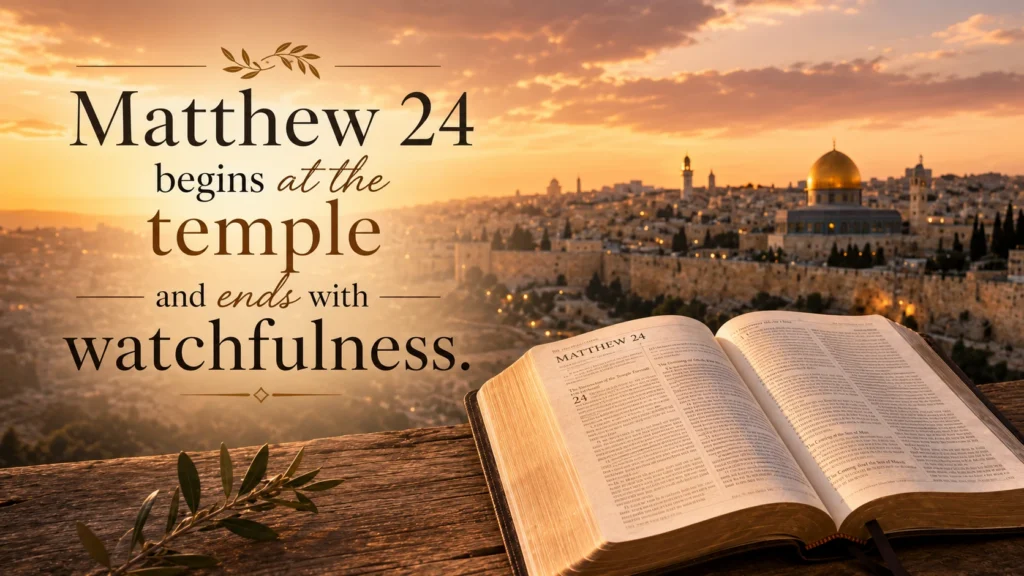
A good reading of these chapters must also reckon with the first-century setting. Jesus begins with the temple. The disciples are looking at the buildings of Jerusalem, and Jesus tells them that not one stone will be left on another. In Luke 21 He becomes even more specific: when they see Jerusalem surrounded by armies, they are to recognise that its desolation is near. That means at least part of the discourse clearly concerns the fall of Jerusalem and the destruction of the temple.
This is one of the main reasons Christians differ in interpretation. Some argue that most of the prophecy is about AD 70. Others say AD 70 is only a foreshadowing of a still-future tribulation. A balanced approach is often wiser. Douglas O’Donnell argues that the disciples initially treat temple destruction and the end of the age as one event, but Jesus unfolds them with more complexity: a local judgment that also prefigures the final judgment. Don Carson, meanwhile, warns against squeezing too much of the chapter into AD 70 alone. Taken together, those insights help us avoid two extremes: flattening everything into the first century, or reading the whole chapter as if it bypassed the first century entirely.
The great warning is not “work out the date” but “do not be deceived”
The most repeated command in these chapters is not “calculate”, but watch. Jesus warns about deception before He discusses chronology. He tells His disciples not to run after false claims of “Here is the Messiah.” He says His coming will not be hidden or private. And then He says, in both Matthew 24 and Mark 13, that no one knows the day or hour. Acts 1:7 presses the same point: the times and dates belong to the Father’s authority. For Christians, that should settle the question of date-setting. It is not spiritual maturity. It is disobedience disguised as certainty.
Why Christians disagree about the details
Christians agree on the centre more than the edges. The centre is that Jesus will return in glory, evil will not win, the dead will rise, and God will judge justly. The edges concern the sequence, imagery, and timing of particular texts.
That is where the major interpretive approaches appear: preterist, historicist, futurist, and idealist. Each one highlights something real. Preterism helps readers take the first-century setting seriously. Historicism insists that prophecy speaks into the long history of the church. Futurism preserves the genuinely future dimension of Christ’s return and final tribulation language. Idealism protects readers from treating apocalyptic symbolism like a newspaper puzzle.
So are we living in the end times
According to Christians, the most responsible answer is yes — but not in the simplistic way the internet often means it. Yes, because the New Testament says the last days began with Christ’s first coming and are still unfolding now. Also yes, because deception, suffering, persecution, and moral confusion are all part of the church’s life in this age. Yes, because Christ may return at any time. But no, in the sense that Christians do not have biblical permission to announce a date, treat every war as final proof, or act as though our generation is the first to live under the shadow of Matthew 24.
There is something strangely comforting about that answer. It means Christians are not called to live by panic. We are called to live by promise. The church has always had to endure difficult days. Paul told Timothy that plainly. Peter said the Lord is not slow in keeping His promise, but patient, wanting people to come to repentance. The point of biblical eschatology is therefore not to create a frightened people, but a faithful one.

How Christians should live in times like these
If Christians believe they are living in the last days, the practical response is not obsession but discipleship. Jesus concludes Matthew 24 by praising the servant who is found faithfully doing his work when the master returns. Peter says the nearness of the end should lead to sober-minded prayer. Paul tells Timothy to remain steady amid difficult times. And 2 Peter says that the promise of the Lord’s coming should produce holy and godly lives. In other words, Christian eschatology is meant to shape character before it satisfies curiosity.
For Christians, the return of Christ is not only a warning about judgment, but also a reminder of the hope of salvation through Jesus.
The same God who fulfilled prophecies about Jesus’ first coming will also fulfill His promises about Christ’s return.
Conclusion
So, are we living in the end times? According to Christians, yes — in the biblical sense that the final era of God’s redemptive plan began with Jesus Christ and will end with His return. But that answer should make us more faithful, not more frantic. Jesus did not give these passages so that we would become captivated by speculation. He gave them so that we would remain awake, steady, holy, and full of hope until He comes.
Frequently asked questions
Are Christians already in the last days?
Yes, in a New Testament sense. Acts 2, Hebrews 1, 1 John 2, and 2 Timothy 3 all speak as though the last days had already begun in the apostolic era. Christians therefore usually understand the last days as the period between Christ’s first coming and His return.
Did Jesus mean AD 70 or the end of the world in Matthew 24?
Many Christians answer: both, in different parts and levels of fulfilment. Luke 21 clearly points to Jerusalem’s desolation, while many readers and commentators think later parts of the discourse also look beyond AD 70 to Christ’s final coming.
Do wars and earthquakes prove that the end has arrived?
Not by themselves. Jesus explicitly says wars, rumours of wars, famines, and earthquakes are the beginning of birth pains, and that “the end is still to come”. They matter, but they are not a permission slip for certainty.
Can anyone know when Jesus will return?
No. Matthew 24 and Mark 13 both say no one knows the day or hour, and Acts 1:7 says the times and dates belong to the Father’s authority. Historic Christianity treats date-setting as a mistake, not a mark of deeper insight.
Why do Christians disagree so much about the end times?
Because apocalyptic passages contain symbolism, near-term historical references, and future hope all at once. That has led Christians to several major interpretive approaches, including preterist, historicist, futurist, and idealist readings, and many teachers combine elements from more than one.
What does 2 Timothy 3 mean by “terrible times in the last days”?
Paul is not speaking only about a final short period just before Christ’s return. He warns Timothy about conditions relevant to Timothy’s own ministry, which is why many Christians understand 2 Timothy 3 as describing the moral character of the church age as a whole, with recurring seasons of unusual difficulty.
Should Christians be afraid of the end times?
Christians are called to seriousness, not fear. Luke 21 speaks of redemption drawing near for believers, 1 Thessalonians 4 presents Christ’s return as comfort for the church, and 2 Peter 3 turns the discussion toward repentance and holy living.
What should Christians do if they think we are in the last days?
Stay watchful, pray, repent, remain faithful in ordinary obedience, and keep sharing the gospel. That is the repeated practical emphasis of Matthew 24, 1 Peter 4, and 2 Peter 3.