By hisscripture
Introduction
Can you be a Christian without going to church? It is a more common question than many people realise. In the United States, Pew’s latest Religious Landscape Study found that 62% of adults identify as Christian, yet only one-third say they attend religious services in person at least monthly and nearly half say they seldom or never attend in person. That does not describe every country or every believer, but it does help explain why this question keeps surfacing today. If you have ever felt like one of the faithful outsiders, you are not alone.
I think this question feels so personal because it is usually not asked in a cold, theological way. Most people are not asking it because they want to win an argument. They are asking it because they feel disappointed, tired, hurt, isolated, anxious, busy, unsure, or spiritually adrift. I have learned that it is possible to sit in a church every week and still feel far from God, and I have also seen sincere people cling to Jesus in seasons when church attendance has been difficult or impossible. The Bible gives a more compassionate and more truthful answer than either harsh legalism or total independence.
The short answer
The short answer is yes: a person is not saved by perfect church attendance. Scripture says salvation is by grace through faith, not by works, which means no one becomes a Christian simply by walking into a building or occupying a pew. If you trust in Christ, your hope is in Him, not in your attendance record. That matters deeply, because guilt can make people believe that missing church automatically means they have lost God altogether, and that is not what the gospel teaches.
If you wish to learn more about Salvation, We have a great article for Understanding Salvation.
But the short answer also needs an honest second half. While church attendance does not save us, the New Testament does not portray Christian faith as a private, self-contained life cut off from other believers. Hebrews tells Christians not to give up meeting together but to keep encouraging one another. Acts describes believers devoting themselves to teaching, fellowship, prayer, shared meals, and shared care. Romans and 1 Corinthians both describe Christians as one body with many parts, which means faith is personal, but it is not merely private.
So if someone asks, “Can you be a Christian without going to church?” my pastoral answer is this: yes, you can belong to Christ in a season when you are not attending church, but long-term Christian health is meant to grow in some form of real fellowship, encouragement, and shared life with other believers.
The biblical basis for Christian community
Hebrews 10:24–25 is one of the clearest passages here, but it is often used in a thin or heavy-handed way. The point of the passage is not “God is keeping score every Sunday morning.” The point is mutual encouragement. Dennis Johnson’s commentary on Hebrews reads the passage as a call for believers under pressure not to withdraw from one another for self-protection, but to keep stirring one another to love and good works. In other words, the command is not cold; it is deeply pastoral. The writer knows people are tempted to pull back, and he tells them not to disappear from the very relationships that could help them endure.
Acts 2:42–47 gives the positive picture. The early church devoted itself to apostolic teaching, fellowship, prayer, breaking bread, generosity, and shared life. Alan Thompson’s Acts commentary notes that this new covenant people were united around the teaching of Jesus through the apostles, and that their fellowship expressed itself in concrete care for one another. What is especially helpful is that Acts 2 does not confine church to a single format. The believers met in the temple courts and in homes. That means church is more than a building and more than a single weekly service, but it is definitely not less than gathered life, prayer, learning, and mutual care.
Romans 12 adds another layer. Paul says our whole lives are meant to be offered to God as “true and proper worship,” and The Gospel Coalition’s Romans commentary makes the useful point that worship in Romans 12 is not meant to be shrunk down to a sacred list of actions in one place. Worship includes everyday obedience. That is important, because it means your faith is not switched off the moment you leave a church building. Yet the same chapter immediately says that though many, we form one body, and each member belongs to all the others. Whole-life worship and shared-body belonging are not rivals; they belong together.
First Corinthians 12 says the same in a different way. Paul’s body metaphor is not decorative. It is corrective. The church needs different members, different gifts, and humble interdependence. Eric Redmond’s 1 Corinthians commentary emphasises that the gifts of the body are for the inclusion, edification, honour, care, and joy of the whole membership. That means one of the great losses of long-term disconnection is not only what we miss from others, but also what others miss from us.

Jesus and church
Matthew 18:20 is one of the most quoted verses in this conversation: “For where two or three gather in my name, there am I with them.” That is a precious promise, but it is often lifted out of its actual setting. In Matthew 18:15–20, Jesus is speaking about confronting sin, taking witnesses, and eventually telling the matter to the church. Douglas O’Donnell’s Matthew commentary says Christ is especially present when the church gathers in that context of discipline and judgment. So yes, Matthew 18:20 absolutely reassures believers that Jesus is present with even a small gathering. But no, it should not be turned into a proof-text for dismissing the church altogether.
I find that both parts of that truth matter. If all you have right now is a small prayer gathering, one trusted Christian friend, or a quiet time with another believer in your kitchen, Jesus is not absent. That promise is real. But Jesus’ own words also assume accountability, reconciliation, and life with His people. He is not inviting us into isolated spirituality that answers to no one.
Can you be a Christian without church?
So can you be a Christian without going to church? If by that question we mean, “Can I still belong to Jesus in a season when I am not attending church?” then yes. There are real seasons when people are housebound, grieving, caring for family, working difficult shifts, dealing with disability, recovering from harm, or living in places where healthy fellowship is genuinely hard to find. In those seasons, I would never want to crush a bruised soul with a shallow answer. Christ does not save us because we managed to keep a religious schedule; He saves us by grace.
But if by that question we mean, “Can I thrive as a Christian while permanently refusing fellowship, accountability, encouragement, and service with other believers?” then the New Testament pushes us to answer much more carefully. Hebrews says not to withdraw from mutual encouragement. Acts shows believers learning and praying together. Romans and 1 Corinthians say we belong to one another as a body. And Paul’s commentary on 2 Timothy insists that endurance does not happen by private devotion alone; believers need bonds with faithful men and women who model endurance.
Personally, I think this is where many of us need the most honesty. Sometimes we are absent because we are wounded. Sometimes because we are exhausted. Sometimes because we genuinely cannot be there. But sometimes we are absent because isolation feels easier than vulnerability, disappointment, or slow growth. The loving thing is not to collapse all of those situations into one. The loving thing is to ask, “What is true about my heart, and what is God gently calling me toward next?”
Practical ways to live your faith outside church
If you are in a season away from church, do not let your spiritual life drift into vagueness. Start with Scripture. Open your Bible consistently, even if the time is simple and short. We have a great article about Finding Time for the Bible.
Then pray honestly, not performatively. You do not have to pretend that everything is fine. If you are disappointed with church, tell God that. If you are tired, say so. If you are afraid of being judged, admit it. Some of the most important prayers are not polished; they are simply truthful.
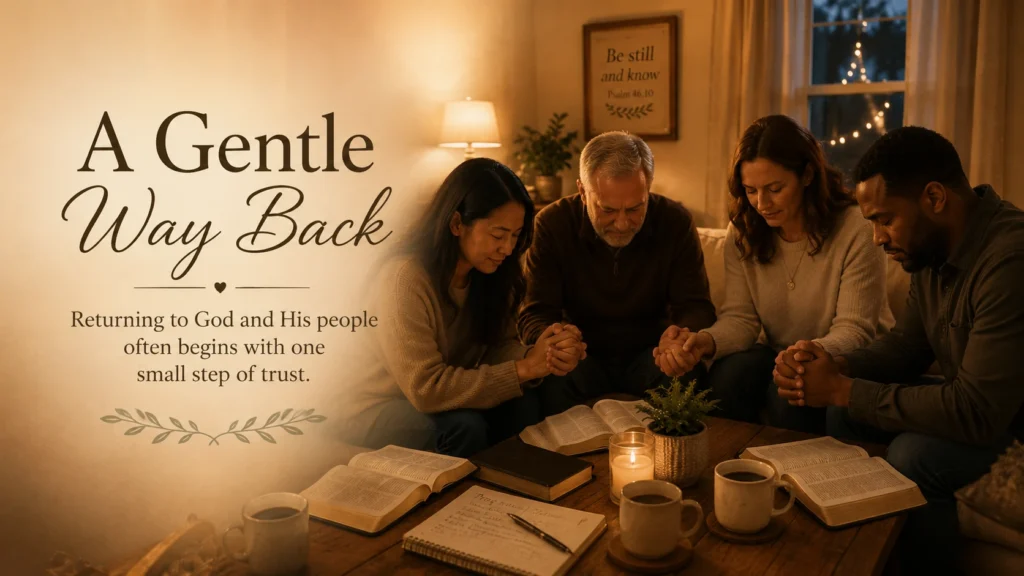
Next, seek some real form of Christian fellowship, even if it is smaller than what you expected. That might mean a mature believer you trust, a weekly home Bible study, a smaller church that feels safer than a large one, or an online service as a temporary supplement rather than a permanent substitute. Acts 2 shows that the church’s life happened in homes as well as gathered public spaces, and Romans 12 and 1 Corinthians 12 both remind us that our gifts are meant to serve others.
And if there is sin, bitterness, numbness, or spiritual confusion in the background, do not try to manage that alone. Turn back to God honestly. Remember the hope of grace rather than assuming you must clean yourself up first. The goal is not to become impressive. The goal is to become honest before God and gradually rooted again in truth, prayer, and fellowship.

Dealing with church hurt
Church hurt deserves its own honest space, because sometimes the real question behind “Can you be a Christian without going to church?” is not laziness at all. It is pain. Sometimes people stay away because they were manipulated, shamed, ignored, spiritually controlled, or deeply disappointed. Second Timothy 3 warns that there can be people who have a form of godliness while denying its power. Scripture is not naïve about distorted religion.
I think one of the hardest parts of church hurt is that it can make good things feel unsafe. Prayer can feel loaded. Singing can feel hollow. Trust can feel reckless. If that is where you are, I would not rush you or shame you. But I would gently say this: Jesus is not the same as the unhealthy people who may have represented Him badly to you. Their failure may be real, but it does not have the authority to define Christ for you.
Hebrews 10 should never be used like a weapon against wounded people. In context, it is a call to stay near the encouragement believers need when they are under pressure and tempted to disappear. That means the passage should move us away from shame and toward care. It should make healthy Christians ask not only, “Why are you not here?” but also, “How can we help carry you?”
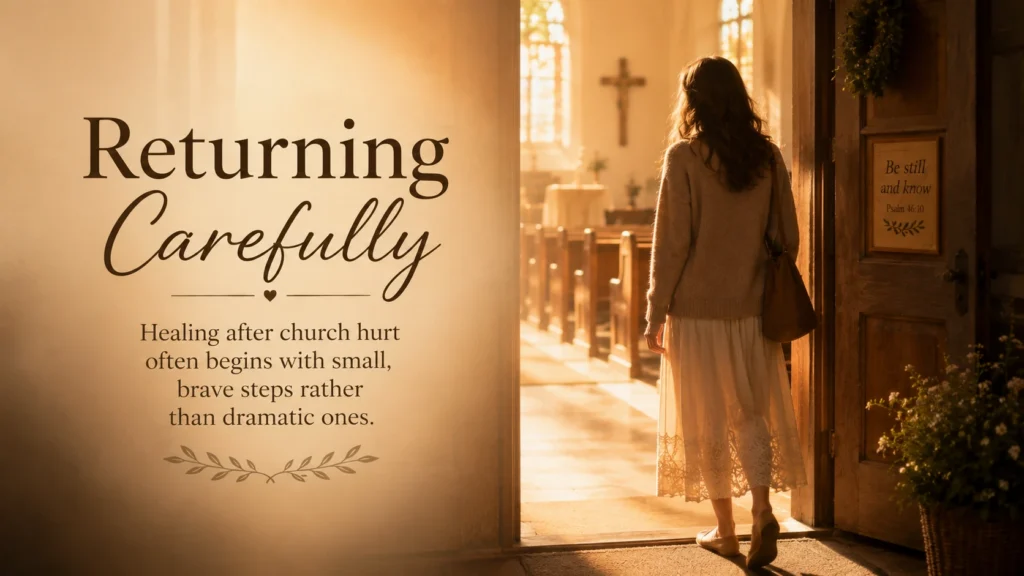
If you are healing from church hurt, start small. Pray honestly. Read Scripture again, even if only a little. Look for humility over image, substance over charisma, and gentleness over pressure. Ask whether a church handles Scripture carefully, treats people with dignity, and makes room for repentance, accountability, and grace. And if what you need first is simply to turn back to God in truth, use that language plainly. That is not failure. That is the beginning of healing.
FAQs
Can you be a Christian without going to church?
Yes, you can truly belong to Christ in a season when you are not attending church, because salvation is grounded in grace through faith, not in external performance. But the New Testament still points believers toward fellowship, encouragement, teaching, prayer, and shared life with other Christians.
Is it a sin not to go to church?
That question needs wisdom, not a blunt slogan. Missing church because of illness, disability, grief, caring responsibilities, work constraints, or genuine recovery from hurt is not the same as turning away from Christian fellowship altogether. The better question is often: am I moving toward Christ, Scripture, prayer, and some honest form of fellowship, or am I simply drifting away? Hebrews 10 challenges drift, not human limitation.
Is online church enough?
Online services can be a real help, especially in hard seasons, and Pew’s current research shows many people do participate in religious services virtually. But the biblical picture of church includes more than watching. It includes fellowship, shared care, mutual encouragement, prayer, and the use of gifts in relationship with other believers. Online participation may be a good bridge, but it is not the fullest picture of embodied Christian life where that is possible.
What if I have been hurt by church?
Then what you feel matters, and it should not be minimised. Scripture itself recognises that there can be distorted forms of religion, and healing may take time. But church hurt should not force you to build your whole understanding of Jesus around the failures of people. Heal carefully, ask for wisdom, keep close to Scripture, and look for healthy Christian community at a pace that is truthful and wise.
Does Matthew 18:20 mean two or three Christians are enough, so I do not need church?
Matthew 18:20 is a beautiful promise of Christ’s presence with gathered believers, but in context it sits inside Jesus’ teaching about accountability, witnesses, and telling matters to the church. It comforts small gatherings; it does not erase the value of the church.
What should I do this week if I have not been to church in a long time?
Take one honest step, not ten imaginary ones. Read one passage of Scripture. Pray one truthful prayer. Message one mature Christian you trust. If you need help beginning again, revisit finding time in the Bible, read a few passages in the Bible verses archive , and if your heart has gone cold or confused, return to God honestly.
Conclusion
So, can you be a Christian without going to church? Yes, in the sense that Jesus saves people, not buildings, and grace is not earned by attendance. But the Bible still calls us away from isolated faith and toward some form of real Christian fellowship, encouragement, prayer, teaching, and shared service. Church is more than a service, more than a structure, and more than a habit. It is the gathered life of God’s people around Christ and His Word.
If this is your story, do not let shame have the final word. Open Scripture today. Pray honestly today. Reach out to one trusted believer this week. And if you need a place to begin, start with finding time in the Bible, revisit the hope of salvation, read a few passages in the Bible verses archive, and take one step back toward God in sincerity. Sometimes faithfulness begins not with a dramatic comeback, but with one quiet act of trust.