 By hisscripture
TL;DR: Among professional historians across beliefs, the existence of Jesus of Nazareth is about as secure as most figures from antiquity. The real debates are about who he was and what exactly he said or did—not did Jesus really exist.
Why This Question Still Matters
I didn’t start wondering whether Jesus existed because I wanted to pick a fight. I wondered because the internet makes bold claims feel certain. One video says “myth,” another says “fact,” and suddenly you’re not just debating history, you’re debating your friends, your family story, maybe even your own identity. That’s why this question matters: it sits where belief, history, and modern expectations about “proof” all collide.
1) We mix up two different questions
There are really two questions:
- Historical: Did a 1st-century Jewish teacher named Jesus live and get executed under Pontius Pilate?
- Theological/Philosophical: Who was he and what does that mean for us?
The first is about evidence and probability. The second is about meaning, worldview, and faith. When we keep those separate, conversations stop overheating. The video you watched makes this point in its own way: historians across beliefs overwhelmingly accept that Jesus existed. The debates that follow are about interpretation, not the basic fact of his life.
2) Our “proof” expectations are modern; the past isn’t
We carry smartphone standards into the ancient world and then feel frustrated when there’s no selfie with an inscriptioned date stamp. But for non-elite people in the 1st century, personal artifacts almost never survive. Even big names can go “invisible” for centuries (think of how Pilate, a top Roman official, was doubted by some until the Pilate Stone turned up in 1961). So if we demand modern-style proof for Jesus, we’d have to delete most of antiquity with him. That double standard is part of why this question keeps resurfacing: our expectations and the ancient record just don’t match.

3) It’s a case study in how we handle evidence—fairly
The video stresses a key idea: apply the same historical standards to Jesus that we apply to everyone else. When we do that, the convergence looks like this:
- Early Christian letters (Paul) within a few decades of Jesus’ death, placing him in a network of named people (James, Peter).
- Gospels that, while later and theological, preserve awkward details you wouldn’t invent about your own heroes (fear, failures, crucifixion).
- Non-Christian notices (Tacitus, Josephus, etc.) that don’t try to sell the faith yet acknowledge the figure and the movement.
- Archaeological backdrop that fits the politics, places, and practices the texts assume (Pilate’s title, crucifixion, Judean offices).
No single piece “proves” anything in isolation; together they make the existence claim ordinary by ancient standards.
4) It matters for skeptics and believers
- If you’re skeptical, it matters because it pushes us toward methodological consistency: don’t quietly raise the bar higher for Jesus than for Socrates or Hannibal.
- If you’re a believer, it matters because faith that faces evidence honestly is stronger than faith that won’t look. The point isn’t to “win”, it’s to understand what history can and can’t tell us.
5) It protects real conversations from dead ends
A surprising number of people (the video cites a UK survey with a big minority) think Jesus might be entirely mythical. When the starting point is “he didn’t exist,” everything else becomes moot. Establishing the basic, boring historical claim, yes, he lived, actually frees us to talk about what’s interesting: What did he teach? Why did he upset people? Why did his followers carry on after his execution? Those are fertile conversations where people can disagree thoughtfully.
6) It keeps humility at the center
Ancient history is probability, not certainty. We don’t have Jesus’ own writings; we work with early letters, remembered sayings, and outside mentions. The video underscores this: even for famous figures, we often lack “direct” evidence and rely on converging testimony. That should make us confident enough to speak plainly, and humble enough to admit limits. Both matter in a good-faith discussion.
This question matters because it teaches us how to think, not just what to think. It asks us to separate existence from meaning, to treat evidence fairly, and to resist the all-or-nothing habits the internet rewards. Start with the modest claim most historians endorse, Jesus of Nazareth existed, and then, with the temperature lowered, move on to the deeper questions that actually shape lives.
How Historians Evaluate Ancient People
When I first dipped into this topic, I half-expected a smoking gun, a signed letter, a selfie in front of the Temple. Then I remembered: that’s our modern appetite for proof sneaking into an ancient pantry. Historians don’t get perfect data; they get fragments. The craft is learning how to weigh those fragments fairly and consistently, whether we’re talking about Jesus, Socrates, or an obscure Roman prefect.
Here’s the common-sense toolkit, plain English, no jargon necessary.
1) Proximity beats perfection
Closer is usually better.
- Earliest surviving sources get more weight than later ones, because memories fade and legends accrete.
- But “early” in antiquity can still mean decades. That’s normal. We don’t dismiss a source just because it isn’t same-day; we ask, how close is it compared to our other options?
Rule of thumb: If you have something within a generation and it connects named people to named places, that’s historically valuable, even if it isn’t a diary.
2) More than one witness (and preferably independent)
Multiple attestation just means different streams saying similar things.
- If two sources are copying each other, that’s still one stream.
- If they come from separate lines (differing style, audience, or origin), confidence goes up.
Why it matters: Converging testimonies reduce the chance that one creative author invented the whole thing.
3) Hostile or neutral voices count extra
Fans can exaggerate; enemies have no incentive to praise.
- A hostile or indifferent source that confirms a basic fact (a person existed, was executed, caused trouble) lands with extra credibility.
- You don’t need an enemy to like your hero, just to acknowledge him.
Think of it as: “Even people who didn’t agree with them had to account for them.”
4) Embarrassing, awkward, and inconvenient details
Historians love material that doesn’t make the authors look good.
- If a movement preserves stories of its leaders failing, fleeing, or being humiliated, those details are less likely to be inventions.
- The point isn’t to revel in flaws; it’s to spot where pride would normally tidy things up, but didn’t.
Practical read: Awkwardness ≠ proof, but it nudges the needle toward authenticity.
5) Fit with the wider world (context coherence)
Texts live inside a real landscape of places, titles, politics, and practices.
- When inscriptions, coins, and archaeology line up with what a text assumes (the right officials in the right era, plausible routes, known punishments), that’s a good sign.
- We rarely get the person’s toothbrush; we often get the stage and props where they plausibly stood.
Example mindset: We didn’t need a stone that says “Socrates taught in the agora at 3pm.” We look for whether the setting is right and whether multiple lines of text point to the same figure.
6) Explain more with less (explanatory power)
Good historical judgments explain the most data with the fewest strained moves.
- “This person existed” is often the simplest way to account for early communities, named relationships, and outside references.
- If a theory requires special pleading (“every line is a late forgery, every outsider was duped”), that’s a red flag.
Test: Which view makes fewer ad-hoc assumptions while fitting what we have?
7) Memory, orality, and the ‘telephone game’ myth
Ancient cultures trained people to remember and retell, especially teachers’ sayings.
- Oral transmission can be stable at the level of themes and characteristic sayings, even if not word-for-word.
- Writing down those traditions a few decades later is typical, not suspicious.
Sanity check: Expect gist-level accuracy plus editorial shaping, not stenography.
8) What historians don’t do (and what they do instead)
- They don’t assume miracles or metaphysics one way or the other.
- They do record what people claimed, when they claimed it, and how those claims spread or changed the world.
- They bracket theological judgments and focus on what the sources, context, and convergence make most probable.
Result: A modest, defensible core you can build conversations on, even when you disagree about meaning.
9) Beware of two bad filters
- Presentism: judging the ancient record by smartphone standards and calling everything “unproven” if it lacks modern receipts.
- Asymmetry: raising the bar higher for one figure (often Jesus) than for comparable figures (Socrates, Hillel, Apollonius). Same methods, same bar.
Fair play rule: However strict you want to be, be consistently strict.
10) A quick checklist you can actually use
When you read a claim about any ancient person, ask:
- How close are our earliest sources?
- How many independent streams point to the same basics?
- Do neutral/hostile sources acknowledge the person or events?
- Do any details look embarrassing or inconvenient for the authors?
- Does it fit the known context (places, titles, dates, practices)?
- Does this explanation account for more facts with fewer stretches than the alternatives?
If several of those land “yes,” you’re on historically solid ground, not certainty, but the kind of confidence ancient history regularly works with.
The Earliest Christian Sources: Evidence for Did Jesus Really Exist?
When people ask “Did Jesus Really Exist?”, historians start with the oldest Christian writings we actually have. That trail doesn’t begin with later church councils or medieval legends, it begins with the undisputed letters of Paul written roughly AD 50–60, within a generation of Jesus’ death. These letters aren’t trying to prove Jesus existed; they assume it, because Paul is busy dealing with real communities, real conflicts, and real people who knew Jesus. That’s why, for the question Did Jesus Really Exist, these sources matter so much.

1) Paul’s earliest letters (AD 50–60): close, connected, and uninterested in myth-making
- Proximity: Letters like 1 Corinthians, Galatians, Romans, Philippians, 1 Thessalonians, Philemon, 2 Corinthians are widely considered authentically Pauline. They’re the earliest surviving Christian texts and land just 20–30 years after the crucifixion, very close by ancient standards.
- Named relationships: Paul says he personally met Cephas/Peter and James, “the Lord’s brother,” in Jerusalem (Gal 1:18–19). That ties Jesus to a concrete network of named individuals in a real place and time, powerful context for the question Did Jesus Really Exist.
- What these letters are (and aren’t): They aren’t modern biographies. But they presuppose Jesus’ life, teaching, execution, and the movement that followed, because Paul is handling pastoral problems, travel plans, and church disputes, not inventing a hero from scratch. For historians, that everyday taken-for-grantedness is exactly what you look for.
Quick read of the passage: Galatians 1:18–19 (KJV)
2) The 1 Corinthians 15 “pre-Pauline” tradition: an early summary before Paul writes it down
In 1 Corinthians 15:3–7, Paul quotes a tight summary he says he “received” and then “delivered”, a formula many scholars see as a preexisting tradition he’s passing on. That tradition centers on Jesus’ death, burial, resurrection claim, and appearances to named witnesses (Cephas, the Twelve, then others). Even very skeptical voices often concede this is earliest tradition, not proof of any miracle, but evidence that core claims about Jesus were circulating before Paul penned the letter. For the historical question Did Jesus Really Exist, that’s significant: it shows organized memory about Jesus within living memory.
Quick read of the passage: 1 Corinthians 15:3–7 (KJV)
3) Why this early Christian evidence carries weight for Did Jesus Really Exist
- Closeness to events: In antiquity, “within a generation” is excellent. Paul’s letters meet that bar.
- Independent corroboration potential: These letters predate later gospels yet harmonize on major basics (teacher from Judea/Galilee; followers; crucifixion under Roman authority; rapid spread afterward). (We’ll bring in non-Christian mentions like Tacitus and Josephus in the next section of your post).
- Real names, real travel, real friction: The texture of Paul’s writing, visits, arguments, collections, co-workers, reads like lived history. That ordinary messiness is exactly what you expect if the movement started around a real person.
4) What these earliest sources don’t do (and why that’s fine)
They’re not stenographic transcripts of Jesus’ speeches; they’re pastoral letters. They don’t settle theological debates about Jesus’ identity either (that’s a different question). But for the narrow historical question “Did Jesus Really Exist?” they give us early, anchored, relational evidence: Paul knows people who knew Jesus, and he cites a tradition that predates his own writing. That’s exactly the kind of convergence historians lean on.
Non-Christian References (Neutral/Hostile): Evidence for Did Jesus Really Exist
For the question Did Jesus Really Exist, historians love sources that aren’t trying to promote Christianity. These neutral, or even hostile, mentions don’t argue theology; they simply acknowledge a figure and a movement that needed explaining.
- Tacitus, Annals 15.44 (c. AD 115): Notes that Christus was executed under Pontius Pilate during Tiberius’ reign and that the movement later spread to Rome. Independent Roman confirmation of the execution context, strong for Did Jesus Really Exist.
- Josephus, Antiquities 20.200 (c. AD 93/94): Refers to “James, the brother of Jesus who is called Christ.” This line is widely regarded as authentic and anchors Jesus to a named family member. (A separate passage, the Testimonium Flavianum, likely has later Christian glosses but preserves a core reference.)
- Pliny the Younger, Letters 10.96–97 (AD 112): Reports that Christians met regularly and sang to Christ “as to a god.” Not proof of beliefs, but early evidence of a widespread community centered on Jesus.
- Suetonius, Life of Claudius 25.4 (c. AD 121): Mentions disturbances among Jews at the instigation of “Chrestus.” Plausibly linked to disputes about the messiah; useful but debated.
- Mara bar-Serapion (late 1st–3rd c.): Refers to a “wise king of the Jews” whose execution brought consequences. Likely Jesus, though the text is brief and not definitive.
Taken together, these outside notices make the existence claim ordinary by ancient standards.
Archaeology & the Story World
When we ask Did Jesus Really Exist, archaeology rarely hands us a plaque that says “Property of Jesus of Nazareth.” What it does give, beautifully, is the stage: officials, punishments, villages, synagogues, roads, and burial customs that match the texts’ world. If the paperwork of an individual peasant teacher almost never survives, the story world still can. And in this case, it does.
1) Pilate, prefects, and Rome’s footprint
The gospels place Jesus’ execution under Pontius Pilate, the Roman prefect of Judea. Archaeology and epigraphy (inscriptions) back that world decisively. The so-called Pilate Stone from Caesarea Maritima names Pontius Pilate, Prefect of Judea, aligning with the titles and locale we’d expect. Coins minted during Tiberius’ reign and the Herodian building program fill in the larger political picture: a province tethered tightly to Rome, with prefects overseeing order from the coast (Caesarea) and shifting their presence to Jerusalem during volatile feasts.
Why it matters for “Did Jesus Really Exist”: the texts’ political scaffolding checks out, down to titles and administrative centers.
2) Crucifixion wasn’t a metaphor—it was policy
Roman crucifixion was a real, state-sanctioned punishment designed to humiliate. Archaeology has even yielded human remains (famously, a heel bone pierced by a nail) that illustrate the practice in 1st-century Judea. Whether a given victim received burial varied by circumstance, but the method and purpose are clear: terror and spectacle for those Rome saw as threats.
Why it matters: the mode of Jesus’ death in the sources fits a punishment Rome actually used in that time and place, no anachronism required.
3) Nazareth: a small agrarian village, not a legend
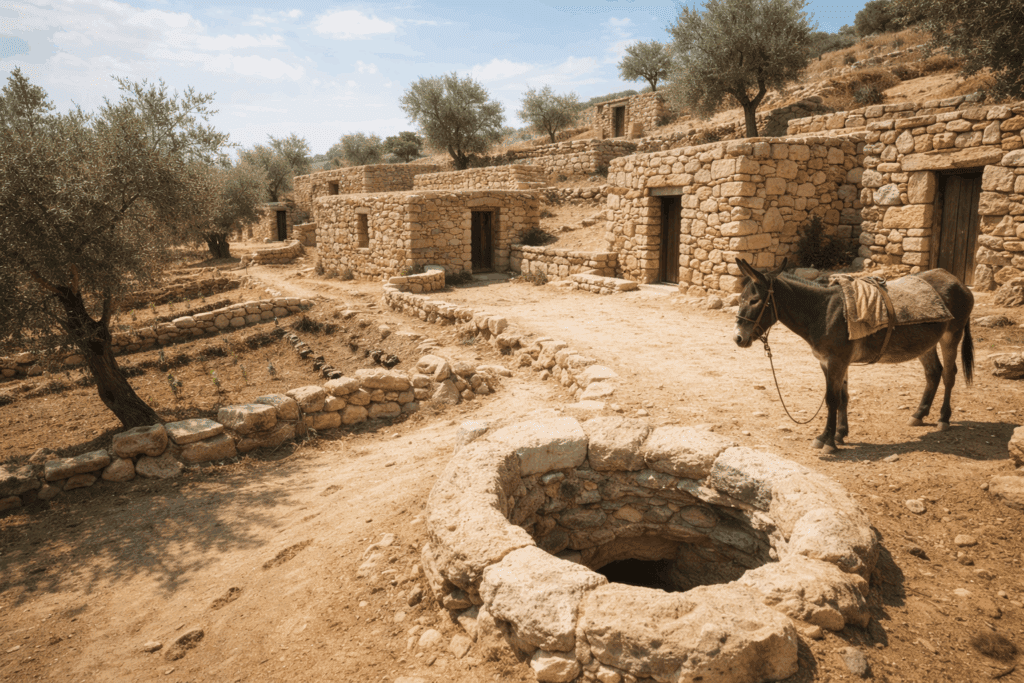
Strip away modern expectations and ask: if a 1st-century teacher grew up in Nazareth, what should we find? Archaeology answers: a modest hill village, rock-cut storage, cisterns, agricultural installations, burial caves, and simple dwellings, tucked in Galilee’s uplands, with larger towns (like Sepphoris) within walking distance. That’s exactly the social and economic profile the texts assume: artisans, farmers, and seasonal laborers moving along footpaths that stitched together Galilee’s villages.
Why it matters: the Did Jesus Really Exist question doesn’t need an inscription; it needs a plausible social setting. Nazareth’s 1st-century footprint provides one.
4) Synagogues and Sabbath teaching: settings that existed
The sources portray Jesus as teaching in synagogues across Galilee and Judea. Archaeology has surfaced several 1st-century synagogues (e.g., in Galilee) and later synagogues built atop earlier phases (e.g., Capernaum’s familiar white limestone hall over earlier basalt). Artifacts like carved stones with menorah motifs and reading platforms show spaces where scripture was read, discussed, and debated.
Why it matters: the teaching venues the texts describe fit with known spaces and practices—no need to invent a setting that didn’t exist.
5) Roads, lakes, and the walking world of a teacher
The Sea of Galilee (a freshwater lake), the Jordan Valley, and upland routes made a preacher’s circuit realistic. Fishing villages ringed the shore; Roman roads and local paths linked lakeside communities with inland towns. It’s not romantic to say teachers could move quickly between villages—it’s logistical.
Why it matters: mobility patterns in the gospels line up with the terrain. The itinerary is geographically believable.
6) Priests, ossuaries, and Jerusalem’s burial culture
Jerusalem’s late Second Temple archaeology is everywhere: monumental steps, ritual baths (mikva’ot), Herodian stones, and a ring of rock-cut tombs from the period. Family burials commonly used ossuaries (stone bone boxes) with names scratched on them; high-status priestly families are represented among finds. This is the burial culture the texts assume, wealthier families with rock-cut tombs, others with simpler interments.
Why it matters: the Did Jesus Really Exist question isn’t solved by a single artifact; it’s strengthened when everyday assumptions (how people buried, washed, and worshiped) are exactly what the ground reveals.
7) What archaeology can, and can’t do
Archaeology can:
- Verify offices, titles, and places the texts assume (prefects, synagogues, Judean towns).
- Confirm punishments and practices (crucifixion, festival crowds, mikva’ot, ossuaries).
- Show a plausible footprint for villages like Nazareth and towns in Galilee where a teacher could gather followers.
Archaeology can’t (usually):
- Hand us a signed object from a non-elite individual like Jesus.
- Arbitrate theological claims.
- Replace texts; it tests them by asking, “Does this fit the real world?”
8) Why this strengthens the historical core
When you put the pieces together, the story world looks exactly like a 30s AD Judea/Galilee should look:
- A Roman prefect named Pilate, operating within Tiberius’ reign.
- A punishment, crucifixion, the state actually used on perceived troublemakers.
- A Nazareth-size village and Galilee-style synagogue network that make a rural teacher plausible.
- Jerusalem as a magnet at feast times, with the frictions such moments amplified.
No single shard answers Did Jesus Really Exist by itself. But the cumulative fit between text and terrain is what historians expect when a narrative grows out of real soil. The ground doesn’t shout a name; it quietly refuses to contradict the basics, and often confirms the scaffolding.
The Modest Scholarly Consensus (“Minimal Facts”)
Historians don’t agree on everything about Jesus, but there’s a modest core that scholars across beliefs can usually sign off on. Think of it as the ground floor—enough to have a serious historical conversation without deciding the theological questions in advance.
What most scholars broadly accept
- A 1st-century Jewish teacher in Galilee/Judea.
He taught, traveled, and drew crowds in the social and religious world you’d expect from late Second Temple Judaism (synagogues, festivals, debates about law and kingdom). - Connection to John the Baptist.
Jesus’ public life is linked to John—likely baptized by him—then continues with a distinct but related message. This association appears in multiple early streams and passes the “why invent it?” test. - A circle of disciples.
Named followers (e.g., Peter) and family ties (e.g., James, the brother of Jesus) anchor him in a real social network. See the verse pages: Galatians 1:18–19 and 1 Corinthians 15:3–7. - Conflict with authorities culminating in crucifixion.
He was executed under Pontius Pilate, a Roman punishment used on perceived troublemakers. This aligns with the political and archaeological backdrop outlined in Archaeology & the Story World and is acknowledged by non-Christian writers (see Non-Christian References). - A movement that persisted and spread after his death.
Within a short span, communities are meeting, organizing, and articulating core convictions. Early summaries (e.g., the creed Paul “received” in 1 Corinthians 15:3–7) show that central claims and named witnesses were already in circulation.
What Is Debated (and Why)
Once you’ve laid the modest historical groundwork, the heat moves to interpretation. Scholars of all kinds religious and not argue about how to read the sources we have. Four debate zones come up again and again: exact sayings & self-understanding, miracle reports, chronology across the gospels, and how memory/oral tradition/editing shaped the texts. Here’s a calm walkthrough.
Exact sayings & self-understanding
Ancient authors didn’t carry voice recorders. What we have are memories, first oral, then written of a teacher whose language was likely Aramaic, preserved for us in Greek. That means two layers of translation: language and genre. Historians often distinguish between ipsissima verba (“the very words”) and ipsissima vox (“the authentic voice/teaching”). In practice, we’re usually closer to the voice than a word-for-word transcript.
This matters when we ask who Jesus thought he was. Debates orbit phrases like “Son of Man,” the kingdom of God, and messiahship. Did he claim these titles explicitly and constantly? Or do the gospels amplify certain threads to speak into their communities? Here, scholars use tools you met earlier—multiple attestation, embarrassment, and context fit—to weigh sayings. Parables and aphorisms that recur across independent streams feel more secure; isolated or highly polished speeches are read more cautiously.
Takeaway: the broad themes (kingdom, parables, call to discipleship, friction with authorities) are stronger than any single, perfectly quoted sentence. The question isn’t “all literal quotes or all invention,” but how close the preserved voice is to the original teacher.
Miracle reports (historical vs. philosophical assessment)
Here two disciplines bump elbows. History can document claims (healings, exorcisms, signs), when and where people made them, how those claims spread, and what social effects followed. Philosophy/theology asks whether such events can occur and what they’d mean if they did.
So the historical debate is not “prove a miracle,” but how to handle miracle reports fairly. Many scholars note that healing/exorcism activity is multiply attested and culturally plausible in 1st-century Judaism; even critics often accept that Jesus had a reputation as a healer/exorcist. “Nature miracles” (stilling a storm, walking on water) are assessed more cautiously because their function is often explicitly theological.
Your own stance matters. A strict naturalist will bracket miracles as legend, yet still acknowledge that the reports themselves are early and help explain the movement’s rapid spread. A theist may be more open to historicity but still recognizes that ancient sources are not lab notes. Either way, responsible readers separate two tasks: (1) What did people claim and when? (a historical question), and (2) Can such things occur? (a philosophical/theological question). Keeping those distinct keeps the conversation honest.
Chronology & differences across the gospels
No ancient biography is a streaming timeline. Evangelists arrange material thematically as well as chronologically, common practice in antiquity. That’s why you’ll see differences that spark genuine debate:
- Temple action timing: In the Synoptics (Matthew/Mark/Luke), the temple incident appears near the end of Jesus’ public activity; in John, it appears near the beginning. Most scholars think one or both authors placed it for theological/structural reasons rather than claiming two identical events.
- Passover chronology: The Synoptics present the final meal as a Passover meal; John seems to place the crucifixion on the day of Preparation (when lambs were being slaughtered). Attempts to harmonize exist, but many scholars simply note the difference and ask what each author wants the reader to see.
- Ministry length: Read straight, the Synoptics can sound like roughly one year; John narrates multiple Passovers, implying two to three years. Again, different narrative aims can shape selection.
- Sermons and locations: “Sermon on the Mount” vs. “on the Plain” may reflect different settings or editorial framing of sayings collections.
Why it isn’t a deal-breaker: despite these differences, the through-line is stable, Galilee/Judea itinerancy, teaching in synagogues and open spaces, conflict, a final trip to Jerusalem, and execution under Pilate. For the basic historical core you established earlier.
Memory, oral tradition, and editorial shaping
Modern readers often picture a chaotic “telephone game.” Ancient Near Eastern reality was different. Teachers trained disciples to memorize and repeat; communities held story-lines in common; and short, portable forms (parables, aphorisms, chreiai) traveled well. That doesn’t make transmission perfect—it makes it structured.
Three anchors help:
- Controlled memory: Communities guarded core stories. That’s why you encounter consistent summaries like the early creed preserved in 1 Corinthians 15:3–7, already in circulation before Paul wrote it down.
- Translation and paraphrase: Moving from Aramaic speech to Greek writing invites paraphrase. Think ipsissima vox again, the recognized voice rather than stenography.
- Redaction (editing) with purpose: Evangelists are not hiding their aims; they select, order, and frame material to speak to real communities. This explains why parallel episodes can be worded differently or placed in different settings while still preserving the same recognizable core.
So what’s debated? The degree of stability. Some argue for a tighter chain (especially around repeated, characteristic sayings); others see more fluidity, with communities freely expanding or compressing scenes. Most sit between those poles: stable cores with editorial shaping around the edges. The lived, ordinary texture of early sources, named associates like Peter and James in Galatians 1:18–19; placeable settings corroborated by context in Archaeology & the Story World, keeps the tradition moored, even as wording varies.
Common Objections—Clear Answers
You don’t need a PhD to navigate the big objections. Here’s a calm, readable guide you can link right in your post. Each answer points to the section (or verse page) where readers can dig deeper.
“There’s no archaeological proof Jesus personally existed.”
Short answer: That’s normal for non-elite 1st-century people. Archaeology rarely preserves personal artifacts; it confirms the world around them.
“The Gospels were written too late and contradict each other.”
Short answer: They’re early by ancient standards, built on earlier traditions, and arranged both thematically and chronologically—standard ancient practice.
“Josephus was forged.”
Short answer: One passage shows likely later Christian glosses, but the James reference (“the brother of Jesus who is called Christ”) is widely accepted.
“Tacitus just repeated what Christians said.”
Short answer: Tacitus was a hostile, elite Roman historian with access to records; he notes Christus was executed under Pilate.
“There are no contemporary Roman records about Jesus.”
Short answer: We lack such records for most people of that era—including many officials. Even Pilate was thinly attested until an inscription surfaced.
“Miracle stories make the accounts unhistorical.”
Short answer: History can’t adjudicate miracles; it can track claims, timing, and impact.
“Jesus is just a mash-up of older myths.”
Short answer: Surface parallels exist across ancient stories, but Jesus’ setting, language, and practices are deeply Jewish Second-Temple—not a generic pagan template.
“If Jesus mattered, why didn’t he write anything?”
Short answer: Most non-elite teachers didn’t. We know many ancient figures through students and communities, not personal notebooks.
“Paul barely mentions biographical details—doesn’t that prove he didn’t care about the real person?”
Short answer: Paul’s letters are occasional—written to solve live problems. He assumes Jesus’ life and teaching rather than re-reporting it.
“Disciples dying for their claims proves everything.”
Short answer: Martyrdom is evidence of sincerity, not automatic proof of every detail. It does help explain the movement’s persistence after the crucifixion, which is part of the historical core.
“Oral tradition = telephone game. Isn’t that unreliable?”
Short answer: Ancient instruction emphasized memorized, repeatable forms (parables, aphorisms). Expect stable cores with editorial shaping in writing.
Timeline & Glossary
A quick, skimmable reference you can keep open while reading the rest of the article. It connects names, dates, and terms to the sections where you’ve already seen them.
Timeline (quick reference)
- c. 6–4 BC — Probable window for Jesus’ birth (late Second Temple period).
- AD 26–36 — Pontius Pilate serves as Roman prefect of Judea.
- c. AD 28–30 — John the Baptist active; Jesus baptized and begins public ministry in Galilee/Judea.
- AD 30 or 33 — Crucifixion under Pilate (date debated; the core event is part of the modest consensus).
- c. AD 33–36 — Paul’s conversion; early contact with Jerusalem leaders follows.
- AD 49 — Claudius expels Jews from Rome (context behind Suetonius mention;).
- AD 50–60 — Undisputed Pauline letters written.
- AD 62 — James (called “the Lord’s brother”) executed in Jerusalem.
- AD 64 — Great Fire of Rome; Nero’s persecution of Christians (context for Tacitus).
- c. AD 65–100 — Gospels composed from earlier oral/written traditions.
- AD 93/94 — Josephus, Antiquities (reference to “James, the brother of Jesus who is called Christ”).
- AD 112 — Pliny the Younger reports on Christians who sing to Christ “as to a god.”
- AD 115–116 — Tacitus, Annals 15.44 (execution of Christus under Pilate).
- c. AD 121 — Suetonius notes disturbances “at the instigation of Chrestus.”
Not every date is certain; what matters is the convergence of early letters, gospel traditions, outside notices, and the 1st-century setting.
Glossary (plain-English)
Annals (Tacitus) — A Roman history that notes Christus was executed under Pontius Pilate; valued as a hostile/neutral confirmation.
Aramaic → Greek — Likely language shift from Jesus’ speech to written sources; explains paraphrase and ipsissima vox.
Criterion of Embarrassment — Historians give weight to awkward details movements wouldn’t invent (e.g., betrayal, flight, crucifixion). Useful but not decisive on its own.
Crucifixion — Roman state execution for perceived threats; the method matches 1st-century Judea’s practice.
Embarrassment (see above) — Shortcut entry pointing back to the criterion.
Ipsissima verba / ipsissima vox — “Exact words” vs. “authentic voice.” With ancient memories/oral transmission, historians often claim the voice more than verbatim sentences.
James, the Lord’s brother — Named in Galatians 1:18–19 and Josephus; anchors Jesus in a concrete family tie.
Josephus — 1st-century Jewish historian. Two passages matter: the James reference (widely accepted) and the Testimonium (likely contains later glosses but preserves a core mention.
Minimal Facts / Modest Consensus — Broad outline many scholars accept: Jesus as a 1st-century Jewish teacher, linked to John, gathered disciples, crucified under Pilate, movement persists.
Multiple Attestation — Independent streams pointing to similar basics; increases confidence when sources aren’t copying each other.
Nazareth — Small Galilean village with 1st-century footprint consistent with the gospels’ setting.
Non-Christian References — Notices from Tacitus, Josephus, Pliny, Suetonius, etc., valued because they aren’t trying to promote Christianity.
Ossuary — Stone bone box used in 1st-century Judean burials; part of the period’s normal funerary landscape.
Pilate (Pontius Pilate) — Roman prefect of Judea during Tiberius. Politically central to the crucifixion context; attested by inscription and coins.
Pliny the Younger — Roman governor whose letters describe Christians worshiping Christ; evidence of early spread and practice.
Redaction — Editorial shaping by gospel writers to serve their audiences (ordering, emphasis, framing) while preserving recognizable cores.
Second Temple Judaism — The Jewish religious/cultural world (c. 516 BC–AD 70) in which Jesus lived—synagogues, festivals, purity practices, scripture debates.
Suetonius — Roman biographer who mentions disturbances among Jews “at the instigation of Chrestus”; debated but contextually interesting.
Synoptic Gospels — Matthew, Mark, and Luke (share much material and perspective); often contrasted with John’s distinct presentation.
Testimonium Flavianum — Josephus passage about Jesus in Antiquities 18; likely contains later Christian embellishments; many scholars still see a historical core reference to Jesus.
FAQs: Clear Answers About Did Jesus Really Exist?
Q1: So… did Jesus really exist?
A: By ordinary standards of ancient history, yes. Multiple early sources, outside notices, and a well-matched 1st-century setting converge on a real person.
Q2: What are the earliest Christian sources?
A: The undisputed letters of Paul (AD 50–60). He knows Peter and James, the Lord’s brother—named associates of Jesus.
Q3: Why isn’t there archaeological “proof” of Jesus himself?
A: Personal artifacts from non-elites almost never survive. Archaeology confirms the world around him—Pilate’s office, crucifixion practice, synagogues, Nazareth’s footprint.
Q4: Did Romans really execute Jesus under Pontius Pilate?
A: That’s the consistent picture in Christian and non-Christian sources.
Q5: Did Jesus write anything himself?
A: No surviving writings. We know him through early letters and traditions preserved in the gospels. Start with Galatians 1:18–19 and 1 Corinthians 15:3–7.
Q6: Don’t differences in the gospels undermine the history?
A: Ancient biographies often arrange material thematically. Differences in order or emphasis are expected; the through-line remains: public teaching, disciples, conflict, crucifixion.
Q7: How do historians treat miracle reports?
A: History tracks claims, timing, and impact; whether miracles can occur is a philosophical/theological question. Many accept Jesus’ reputation as healer/exorcist, while bracketing mechanism.
Q8: Was Josephus tampered with?
A: One passage likely has later Christian glosses, but the line about “James, the brother of Jesus who is called Christ” is widely accepted.
Q9: How reliable is oral tradition? Isn’t it “telephone”?
A: Ancient teaching relied on memorized, repeatable forms (parables, aphorisms). Expect stable cores with editorial shaping in writing.
Q10: Why does Nazareth matter?
A: It shows a plausible social setting: a small Galilean village within walking distance of larger towns—exactly the world the texts assume.
Conclusion & Final Thoughts
If you strip away the noise and keep the rules of ancient history consistent, the answer to Did Jesus Really Exist comes out modest and solid: a 1st-century Jewish teacher from Galilee/Judea gathered disciples, clashed with authorities, and was crucified under Pontius Pilate. That core is supported by early Christian letters tied to named people, non-Christian notices that aren’t trying to promote the faith, and an archaeological backdrop that matches the stage the texts assume.
From there, good-faith debates begin, about exact sayings and self-understanding, how to read miracle reports, the chronology of events across the gospels, and how memory/oral tradition/editing shaped what we have. Those aren’t distractions; they’re where careful reading lives. History gives you probabilities; theology and philosophy ask what those probabilities mean for life.
My hope is that this guide lowers the temperature and raises the light. Start with the minimal facts most scholars accept. Then, if you’re curious, walk the sources yourself: read the verse pages, skim the outside references, and notice how well the world of late Second Temple Judaism fits the story the texts tell. You don’t have to settle every question to speak plainly about the basics.
If this helped you or someone you love think more clearly, share it, and keep exploring. The best conversations aren’t about “winning,” but about seeking truth with humility and consistency.
Thanks for reading—and for caring enough to ask careful questions.
Join Our Newsletter
Would you like more insights into God’s love, forgiveness, and practical ways to live out your faith? Join our newsletter! You’ll receive weekly encouragement, Bible-based wisdom, and resources to help you grow spiritually. Sign up today and stay connected with us as we explore God’s Word together.